

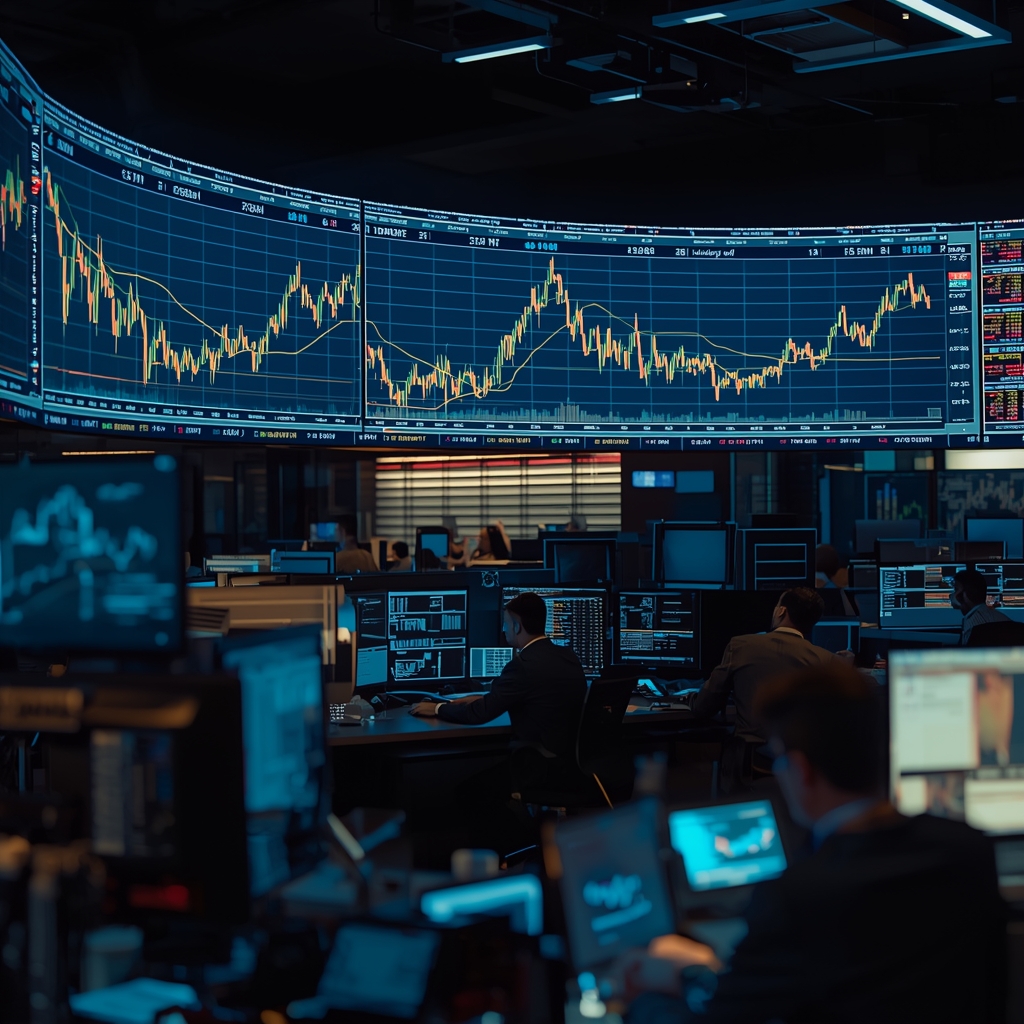
Perzix Daily Market Intelligence: When Volatility Becomes the Signal
The market is no longer moving in a straight line—and that may be the most important signal of all. Oil spikes, then drops. Bonds sell off, then rally. Equities swing between fear and relief within days. This is not confusion. It is a transition.
Quick Take: Rapid reversals across oil, bonds, and equities suggest markets are shifting into a volatility-driven regime where positioning and timing matter more than direction.
What Happened Today
Over the past several sessions, markets have struggled to hold a consistent narrative. Headlines tied to Middle East tensions pushed oil sharply higher toward extreme levels, dragging down equities and bonds in a classic risk-off move. Shortly after, renewed hopes of de-escalation reversed much of that pricing, sending futures and bonds higher while oil retreated below key psychological thresholds.
This pattern—sharp move, rapid reversal—is now repeating. It is visible across asset classes: energy reacting violently to geopolitical headlines, equities oscillating between relief and caution, and bonds struggling to anchor expectations. Even currency markets reflect this instability, with safe-haven flows appearing and fading quickly.
What matters is not the direction of any single move. It is the speed at which conviction collapses.
Politics Into Prices
The political driver is straightforward: uncertainty around the trajectory of the Iran conflict and broader regional stability. But the market impact is less about the event itself and more about its probability distribution.
Each new statement or signal—from escalation rhetoric to hints of withdrawal—forces investors to rapidly reprice outcomes: supply disruption versus normalization, inflation shock versus stabilization, policy tightening versus relief.
This creates a feedback loop. Oil spikes raise inflation fears, which pressure bonds and equities. Then de-escalation headlines compress those fears just as quickly, reversing flows. The result is not a steady repricing but a sequence of overlapping, incomplete adjustments.
In effect, politics is no longer pushing markets in one direction. It is increasing the range of possible outcomes—and forcing markets to trade that range.
Why It Matters
A market defined by reversals behaves very differently from a trending one. In trending environments, positioning can be rewarded through patience. In volatile regimes, timing and risk control dominate.
This shift has consequences. First, traditional signals lose clarity. A rise in oil no longer guarantees sustained inflation pressure. A bond rally does not necessarily signal durable safety demand. Each move must be interpreted in context, not extrapolated.
Second, liquidity becomes more fragile. Rapid repositioning increases the likelihood of sharp intraday moves, particularly when consensus builds too quickly in one direction.
Third, narratives lose durability. The market is no longer “risk-on” or “risk-off” in a stable sense. It is oscillating between the two, sometimes within the same week.
For readers of Perzix, this is a shift from directional thinking to probabilistic thinking.
Business / Investor Lesson
In volatile regimes, the biggest mistake is overcommitting to a single scenario. Businesses and investors alike need to structure decisions around ranges, not point forecasts.
For operators, this means stress-testing costs and demand under multiple energy price scenarios. A temporary spike in oil may not justify structural changes, but repeated spikes should influence hedging and pricing strategies.
For investors, it means adjusting position sizing and time horizons. Large, concentrated bets become riskier when narratives reverse quickly. Incremental positioning, optionality, and liquidity buffers gain importance.
The practical takeaway is simple: resilience beats precision. In uncertain environments, being approximately right across scenarios is more valuable than being exactly right once.
Term / Trend Focus
Volatility Regime Shift
A volatility regime shift occurs when markets move from relatively stable, trend-following behavior into an environment of frequent, large price swings. In such regimes, correlations change, risk models become less reliable, and short-term positioning has a greater impact on price action.
This does not mean markets are broken. It means the dominant driver has changed—from direction to dispersion. Instead of asking “where is the market going,” participants must ask “how wide is the range, and how fast can it change.”
Historically, these regimes tend to emerge during periods of policy uncertainty, geopolitical tension, or transitions in monetary conditions.
Market Snapshot
Oil remains the epicenter of volatility, with recent data showing a sharp monthly jump followed by rapid intraperiod swings. The move toward elevated levels reflects supply risk, but the inability to hold those levels signals skepticism about sustained disruption.
Equities and bonds are both reacting to these swings rather than leading them, highlighting oil’s role as the transmission mechanism into broader risk sentiment.
Gold’s longer-term climb suggests underlying demand for protection remains intact, even as short-term flows fluctuate. Bitcoin data is less clear in this snapshot, but its behavior in similar environments tends to reflect liquidity conditions more than geopolitical hedging.
The combined message: markets are not pricing a single outcome—they are pricing a widening range of outcomes.
What Perzix Is Watching Next
The key question is whether volatility stabilizes or accelerates. The base case is continued two-way trading, with oil oscillating within a high but contained range and other assets reacting accordingly. This would imply ongoing uncertainty without systemic stress.
The stress case emerges if oil breaks higher and holds, forcing a sustained inflation repricing and tightening financial conditions. In that scenario, the current volatility could evolve into a more directional risk-off move.
The invalidation signal would be a clear and credible de-escalation path that compresses oil volatility and allows bonds and equities to re-anchor around growth and policy fundamentals rather than geopolitical noise.
Until then, volatility itself remains the most reliable indicator—and the one the market is trading most aggressively.
The shift is subtle but important: the signal is no longer where prices end up, but how violently they move to get there.
🇪🇸 Resumen en Español
Los mercados no siguen una dirección clara; están oscilando con fuerza. El petróleo sube por tensiones geopolíticas y luego cae ante señales de desescalada. Bonos y acciones reaccionan de forma similar, reflejando un cambio hacia un régimen dominado por la volatilidad. Este entorno obliga a los inversores a pensar en probabilidades, no en escenarios únicos. La incertidumbre política amplía el rango de resultados posibles, generando repricing constante. La lección clave es priorizar resiliencia sobre precisión. El próximo foco está en si la volatilidad del petróleo se estabiliza o escala, determinando si el mercado mantiene oscilaciones o entra en una tendencia más definida.
🇨🇳 中文摘要
当前市场的关键特征不再是方向,而是波动性。油价因中东局势紧张而大幅上涨,又因缓和预期迅速回落,带动债券和股市反复波动。这表明市场正在进入一个“波动性主导”的阶段,而不是趋势驱动。政治不确定性扩大了结果范围,迫使资产不断重新定价。在这种环境下,投资者应重视概率和风险管理,而非单一预测。企业和投资者都需要增强韧性。接下来需观察油价波动是否持续,这将决定市场是继续震荡,还是转向更明确的方向。
🇷🇺 Краткое резюме
Рынки больше не движутся в одном направлении — они колеблются. Нефть растёт на фоне геополитики и падает на ожиданиях деэскалации, вызывая резкие движения в акциях и облигациях. Это указывает на переход к режиму, где ключевым фактором становится волатильность. Политическая неопределённость расширяет диапазон возможных исходов, заставляя рынок постоянно переоценивать риски. В таких условиях важнее гибкость и управление рисками, чем точные прогнозы. Бизнесу и инвесторам стоит готовиться к разным сценариям. Главный вопрос — сохранится ли высокая волатильность нефти или начнётся стабилизация.
🇸🇦 ملخص بالعربية
لم تعد الأسواق تتحرك في اتجاه واحد، بل أصبحت تتقلب بسرعة. ارتفعت أسعار النفط بسبب التوترات الجيوسياسية ثم تراجعت مع توقعات التهدئة، ما أدى إلى تحركات حادة في الأسهم والسندات. هذا يشير إلى دخول الأسواق في نظام تقوده التقلبات وليس الاتجاهات. عدم اليقين السياسي يوسع نطاق النتائج المحتملة، ويجبر المستثمرين على إعادة التسعير باستمرار. في هذا السياق، تصبح المرونة وإدارة المخاطر أهم من التوقعات الدقيقة. على المستثمرين والشركات الاستعداد لسيناريوهات متعددة. العامل الحاسم القادم هو ما إذا كانت تقلبات النفط ستستمر أم ستستقر.
🇫🇷 Résumé en Français
Les marchés ne suivent plus une trajectoire claire, ils oscillent fortement. Le pétrole grimpe avec les tensions géopolitiques puis recule avec les espoirs de désescalade, entraînant actions et obligations dans des mouvements rapides. Cela signale un passage à un régime dominé par la volatilité. L’incertitude politique élargit la gamme des scénarios possibles et force des ajustements constants des prix. Dans cet environnement, la résilience et la gestion du risque priment sur les prévisions précises. Les investisseurs doivent raisonner en probabilités. Le point clé à surveiller est la persistance de la volatilité du pétrole.

Perzix Daily Market Brief: The Bond Market Beneath the Oil Relief | “09 27, 2026”
The latest market signal was not simply that oil eased or futures bounced on diplomacy hopes. The de

Perzix Daily Market Brief: What the Market Heard After Oil Went Quiet | “06 20, 2026”
The day’s key signal was not simply risk-on. As oil fear cooled on Iran de-escalation hopes, marke

Perzix Daily Market Brief: What the Market Heard in Falling Oil | “09 22, 2026”
The day’s signal was not simply that oil fell or equities rose. It was that stocks and bonds moved

Leave a Reply