

Perzix Daily Market Intelligence: When Risk Starts Trading Both Ways
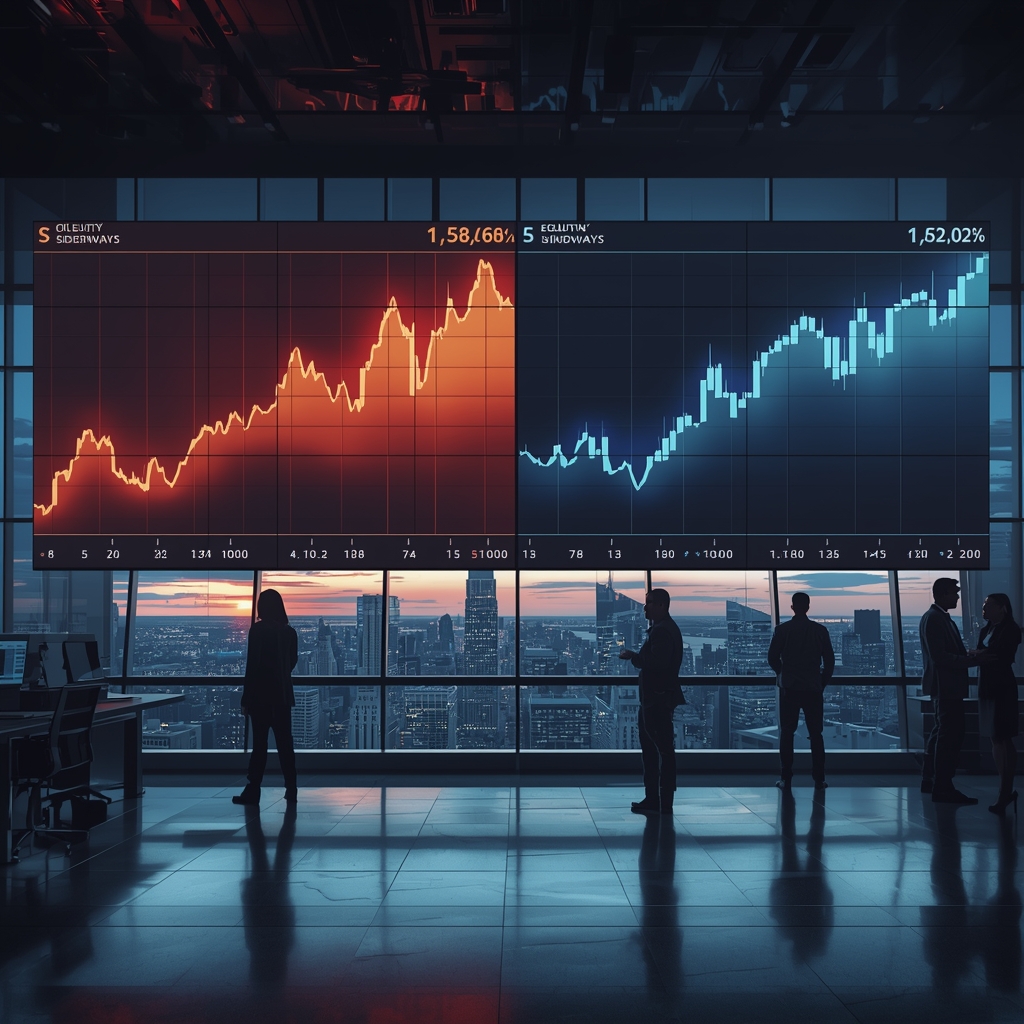
Oil jumps on disruption fears, then equities recover on ceasefire headlines, only to wobble again as negotiations stall. The pattern is no longer directional—it is oscillating. What stands out now is not the volatility itself, but the lack of conviction behind it.
Quick Take: Markets are shifting from one-way geopolitical pricing to a two-sided regime where the same risk is traded both positively and negatively, compressing conviction and raising the importance of timing over direction.
What Happened Today
Futures drifted lower as uncertainty around US–Iran talks persisted, with reports of intercepted vessels and fragile negotiations keeping oil elevated and risk sentiment uneven. Yet the same geopolitical backdrop has recently produced rallies when ceasefire extensions appeared plausible, even as crude prices pushed higher.
This creates a confusing surface narrative: oil strength typically signals risk-off conditions, but equities are no longer consistently following that script. Instead, markets are reacting to incremental changes in probability rather than to the absolute level of risk.
Elsewhere, central bank signals remain active in the background. The Swiss National Bank’s rate cut and currency strength highlight that monetary policy is still adjusting beneath the geopolitical layer, even if it is not the dominant driver of daily price swings.
Politics Into Prices
The political variable is not simply “conflict” versus “peace.” It is the credibility and durability of each outcome. A stalled negotiation does not carry the same pricing weight as a confirmed escalation, and a temporary ceasefire does not fully remove supply risk from oil markets.
This produces a split transmission mechanism. On one side, energy markets continue to price supply disruption risk, pushing crude higher when shipping lanes appear threatened. On the other, equity markets increasingly price the probability that disruption remains contained or temporary.
The result is a divergence in how different assets interpret the same headline. Oil reacts to worst-case pathways. Equities react to median-case probabilities. Currencies and rates sit somewhere in between, adjusting to both risk sentiment and central bank positioning.
Why It Matters
This is a meaningful shift from earlier phases of the same geopolitical story. Previously, markets tended to move in unison—risk-on or risk-off depending on the dominant narrative. Now, that synchronization is breaking down.
When markets lose a single directional anchor, volatility becomes less about trend and more about sequencing. The order in which news arrives starts to matter more than the news itself. A negative headline followed quickly by a stabilizing signal produces a different outcome than the reverse, even if the net information is similar.
Historically, this resembles mid-2019, when tanker incidents in the Gulf briefly pushed oil higher without triggering sustained equity selloffs. The market learned to price disruption as episodic rather than systemic, leading to choppier but less directional behavior.
That kind of environment rewards flexibility and penalizes rigid positioning.
Business / Investor Lesson
For operators and investors, the key shift is from directional conviction to scenario management. When the same risk can drive both upside and downside reactions within days, the question is no longer “what is the outcome?” but “how fast can it change?”
Companies exposed to energy costs, logistics, or cross-border trade should avoid anchoring to a single scenario. Instead, they need to build buffers—contract flexibility, pricing clauses, or inventory strategies—that can adapt to rapid reversals.
Investors face a similar adjustment. In a two-sided market, entry points and time horizons matter more than broad macro calls. Being right on direction but wrong on timing can be as costly as being wrong outright.
At Perzix, this is where decision-making discipline becomes more valuable than prediction. The environment favors those who can update quickly rather than those who insist on being early.
Term / Trend Focus
Two-Sided Risk: A market condition where a single underlying uncertainty drives both bullish and bearish price reactions, depending on shifting probabilities and timing rather than a fixed directional view.
In a one-sided regime, risk is consistently priced in the same direction—either amplifying fear or reinforcing optimism. In a two-sided regime, the same variable (such as geopolitical tension) can alternately support and undermine asset prices.
This often emerges when markets gain confidence that extreme outcomes are unlikely, but not enough confidence to ignore the risk entirely. The result is range-bound volatility with frequent reversals.
Market Snapshot
Oil remains the most sensitive barometer, reacting quickly to shipping disruptions and negotiation headlines. Equities, by contrast, are showing signs of resilience, no longer selling off in a straight line alongside energy spikes.
The dollar has firmed modestly, supported by relative policy stability and safe-haven flows, while rate signals remain mixed as central banks continue to adjust in the background.
Gold’s behavior—though data is limited today—typically reflects this kind of environment by holding firm without accelerating, signaling caution rather than panic. Bitcoin, similarly constrained by incomplete data here, tends to act more as a liquidity-sensitive asset than a pure geopolitical hedge, and likely mirrors the broader hesitation rather than leading it.
The cross-asset message: markets are not ignoring risk, but they are no longer agreeing on how to price it.
What Perzix Is Watching Next
The base case is continued oscillation—oil elevated but contained, equities range-bound, and headlines driving short-term swings rather than sustained trends.
The stress case would involve a clear escalation that disrupts shipping in a sustained way, forcing equities to reprice toward oil’s more pessimistic signal.
The invalidation signal is equally important: a durable and credible agreement that stabilizes transit routes would likely compress oil prices and restore directional risk-on behavior across assets.
Until one of those paths becomes dominant, expect markets to keep trading both sides of the same story.
That is not confusion. It is adaptation to uncertainty that refuses to resolve cleanly.
🇪🇸 Resumen en Español
Los mercados están dejando de reaccionar en una sola dirección ante los riesgos geopolíticos. El petróleo sube por temores de interrupción, mientras las acciones se mantienen más resilientes, reflejando probabilidades distintas. Este entorno de “riesgo bidireccional” implica que el mismo evento puede impulsar subidas o caídas según cambie la percepción. Históricamente, situaciones similares generan volatilidad sin tendencia clara. Para empresas e inversores, la clave ya no es predecir un resultado, sino adaptarse rápidamente. El escenario base es de oscilación continua; el riesgo es una escalada sostenida, y la señal de alivio sería un acuerdo creíble que estabilice el mercado energético.
🇨🇳 中文摘要
市场对地缘政治风险的反应正从单向转为双向。油价因供应中断担忧上涨,而股市则更倾向于定价“冲突可控”的情景,导致资产之间出现分歧。这种“双向风险”意味着同一事件可以根据概率变化带来上涨或下跌。类似2019年的环境通常带来震荡而非趋势行情。对企业和投资者而言,关键不再是预测结果,而是提高应变能力。基准情景是震荡延续;压力情景是运输受阻导致全面风险重定价;若出现可信协议,油价风险溢价将下降并恢复风险偏好。
🇷🇺 Краткое резюме
Рынки переходят от односторонней реакции на геополитику к двустороннему режиму. Нефть растёт на страхах перебоев, тогда как акции остаются устойчивыми, оценивая более умеренный сценарий. Это создаёт «двусторонний риск», при котором один и тот же фактор может вызывать как рост, так и падение цен. Исторически такие периоды сопровождаются волатильностью без устойчивого тренда. Для бизнеса и инвесторов важнее гибкость, чем прогноз. Базовый сценарий — колебания; стресс — длительное нарушение поставок; сигнал разворота — надёжное соглашение, снижающее риск-премию нефти.
🇸🇦 ملخص بالعربية
تتحول الأسواق من تسعير أحادي الاتجاه للمخاطر الجيوسياسية إلى بيئة ثنائية الاتجاه. ترتفع أسعار النفط بسبب مخاوف الإمدادات، بينما تظهر الأسهم مرونة أكبر، ما يعكس اختلافاً في تقييم الاحتمالات. هذا “الخطر ثنائي الاتجاه” يعني أن نفس الحدث قد يدفع الأسواق صعوداً أو هبوطاً حسب تغير التوقعات. تاريخياً، تؤدي هذه الظروف إلى تقلبات دون اتجاه واضح. بالنسبة للشركات والمستثمرين، الأهم هو القدرة على التكيف لا التنبؤ. السيناريو الأساسي هو التذبذب، والسيناريو السلبي هو تصعيد مستمر، أما الإشارة الإيجابية فهي اتفاق موثوق يخفف علاوة المخاطر.
🇫🇷 Résumé en Français
Les marchés ne réagissent plus de façon unidirectionnelle aux risques géopolitiques. Le pétrole monte avec les craintes de perturbation, tandis que les actions restent relativement résilientes, traduisant des anticipations différentes. Ce « risque bilatéral » signifie qu’un même événement peut entraîner des mouvements opposés selon les probabilités perçues. Historiquement, ces phases génèrent de la volatilité sans tendance claire. Pour les entreprises et investisseurs, l’enjeu est l’adaptabilité plutôt que la prévision. Le scénario central reste une oscillation des marchés, avec un risque en cas d’escalade prolongée et un apaisement si un accord crédible émerge.

Perzix Daily Market Brief: The Chip Shock Behind the Payrolls Test | “07 3, 2026”
A sharp South Korean equity selloff put semiconductor concentration back in focus just as U.S. payro

Perzix Daily Market Brief: What Tech Heard in Broadcom’s Forecast Miss | “06 7, 2026”
Broadcom’s weaker outlook did more than pressure chip stocks. It reminded investors that the AI tr
Perzix Daily Market Capsule: When Oil Becomes the Market’s Trigger Level
Markets are no longer reacting to headlines alone—they are reacting to a level. As oil approaches

Leave a Reply