

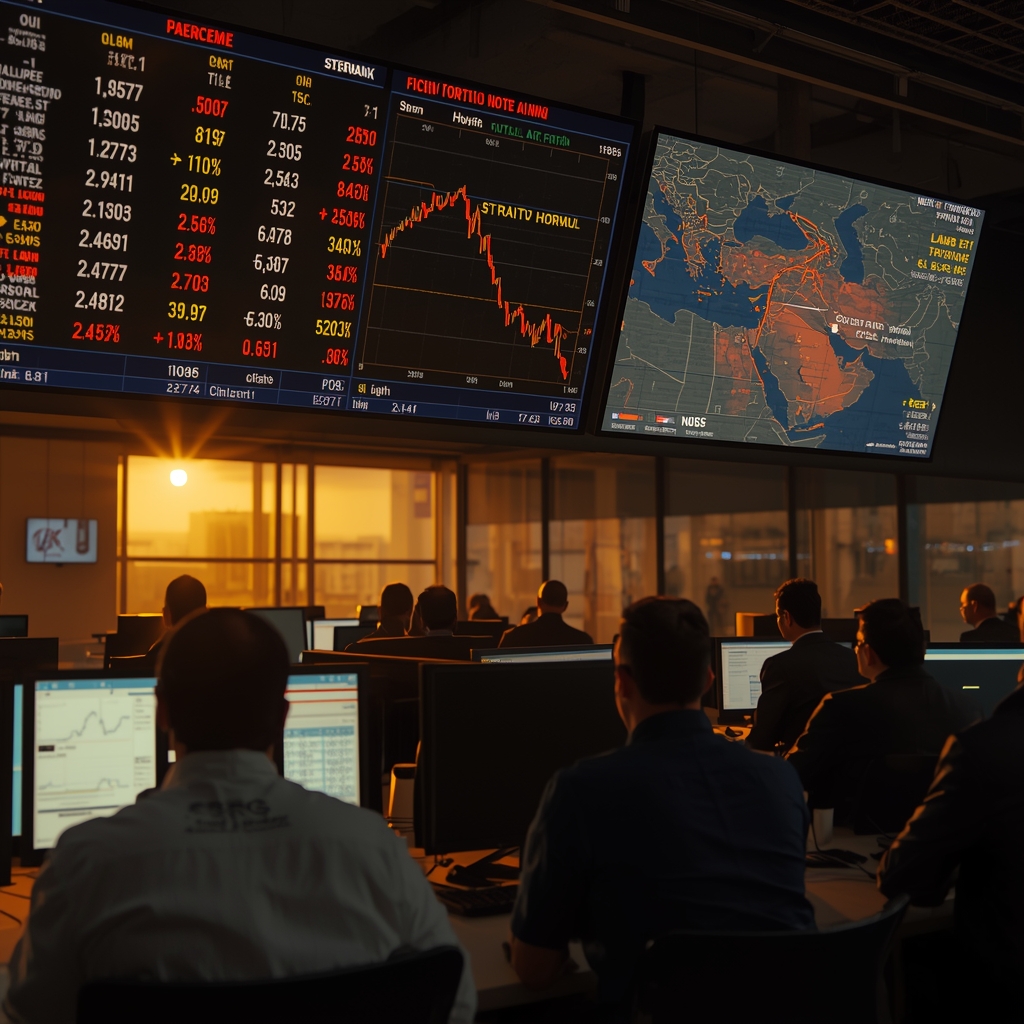
Perzix Daily Market Capsule: When Oil Breaks the Fear Feedback Loop
Markets opened today with a subtle but important shift in tone: the feedback loop between geopolitical fear and asset prices is starting to weaken. Equity futures pushed higher while oil prices slipped, even as the Middle East conflict continues into its third week. That divergence is the signal.
Quick Take: When oil stops rising on bad news and equities start climbing anyway, markets are no longer amplifying fear—they are beginning to break the feedback loop that sustains risk premiums.
What Happened Today
U.S. equity futures moved higher, recovering from recent losses, while crude oil prices declined modestly on renewed hopes that transit through the Strait of Hormuz may remain intact. The shift comes after several sessions where energy markets dominated broader risk sentiment.
The change is not about resolution—there is no clear end to the conflict—but about probability. Markets are increasingly pricing a scenario where worst-case supply disruptions do not materialize. That alone is enough to change positioning.
Technology names were broadly stable to higher in premarket trading, while global markets showed mixed signals, with Asia still reflecting earlier stress. The key, however, is not regional divergence—it is the cross-asset relationship between oil and equities starting to loosen.
Politics Into Prices
The political driver remains centered on the Middle East, specifically the risk to shipping lanes and energy flows. Reports of backchannel outreach and diplomatic signaling—whether credible or not—are feeding expectations that escalation may be contained.
This creates a clear transmission mechanism: perceived de-escalation lowers the probability of supply disruption → lower expected energy prices → reduced inflation risk → less pressure on central banks → improved equity sentiment.
Importantly, markets are not waiting for confirmation. They are trading on trajectory. As Perzix has emphasized in recent capsules, markets are forward-looking systems that price probabilities, not outcomes. Even a small shift in perceived risk can unwind a large portion of the embedded premium.
Why It Matters
For weeks, oil has functioned as the transmission channel of fear. Every headline fed into higher crude prices, which in turn reinforced inflation concerns and pressured equities. That is the classic risk amplification cycle.
Today suggests that cycle is weakening. Oil falling despite ongoing conflict signals that the market is no longer reacting mechanically to headlines. Instead, it is filtering them through a more nuanced probability framework.
This matters because once the feedback loop breaks, price action can stabilize faster than the underlying situation improves. Markets do not need peace—they need less uncertainty about worst-case outcomes.
That distinction often marks the turning point between fragile volatility and more durable risk appetite.
Business / Investor Lesson
The practical lesson is about recognizing when a narrative loses its pricing power. Not all risks are equal, and more importantly, not all risks remain equally influential over time.
When a market stops reacting to the same stimulus—such as geopolitical headlines—it is often signaling saturation. Positioning is already aligned with that risk, and incremental news has diminishing impact.
For investors, this is where opportunity begins to emerge. The edge is not in predicting the event, but in recognizing when the market’s sensitivity to that event is fading.
For businesses, especially those exposed to energy costs or supply chains, this shift offers a window to reassess hedging, pricing strategies, and inventory decisions. The cost of overreacting to yesterday’s risk can be as high as ignoring tomorrow’s.
Term / Trend Focus
Fear Feedback Loop: This refers to a self-reinforcing cycle where negative news drives asset prices in a way that amplifies the perceived risk itself.
In this case: geopolitical tension pushes oil higher → higher oil increases inflation concerns → inflation concerns pressure equities → falling equities reinforce risk aversion → which then feeds back into higher demand for oil as a hedge.
Breaking this loop is significant. It means markets are no longer reflexively amplifying risk. Instead, they are beginning to differentiate between scenarios and assign probabilities more selectively.
That shift tends to reduce volatility over time, even if the underlying uncertainty remains.
Market Snapshot
Equities and oil are sending a coordinated signal: risk appetite is stabilizing as energy-driven fear recedes. The drop in oil prices, particularly around key psychological levels, is easing inflation pressure expectations and supporting equities.
Gold’s behavior remains a key tell—if it holds firm while equities rise, it suggests lingering macro caution beneath the surface. Bitcoin, while not precisely quoted today, typically acts as a higher-beta expression of liquidity and sentiment; its direction relative to equities will help confirm whether this is a durable shift or a short-covering bounce.
Currencies show a mixed but telling picture, with the dollar firming modestly in some crosses, suggesting that while risk is improving, markets are not fully abandoning defensive positioning.
The combined message: this is not full risk-on, but it is no longer risk-off driven by energy panic.
What Perzix Is Watching Next
The next phase depends less on headlines and more on confirmation. The base case is that oil continues to drift lower or stabilize, allowing equities to extend their recovery as inflation fears ease. In this scenario, markets gradually rebuild risk appetite without requiring a formal resolution.
The stress case is a sudden disruption—whether physical or perceived—in key shipping routes, which would quickly reprice oil higher and re-ignite the feedback loop. Markets remain highly sensitive to that tail risk, even if it is currently being discounted.
The invalidation signal would be oil rising sharply despite continued diplomatic signals. That would suggest the market is losing confidence in the de-escalation narrative and could trigger a rapid reversal in equities.
For now, the signal is clear: markets are starting to trust that the worst-case scenario may not be imminent. And in markets, that shift in belief is often more powerful than the eventual outcome.
The challenge, as always, is recognizing whether this is the beginning of stability—or simply a pause before the next shock.
🇪🇸 Resumen en Español
Los mercados muestran un cambio clave: el petróleo cae mientras las acciones suben, incluso con el conflicto en Medio Oriente en curso. Esto sugiere que se está rompiendo el “bucle de retroalimentación del miedo”, donde el alza del crudo alimentaba inflación, presión sobre acciones y mayor aversión al riesgo. Ahora los inversores empiezan a valorar probabilidades en lugar de reaccionar a titulares. La posible estabilidad en el estrecho de Ormuz reduce el riesgo percibido. Si el petróleo se mantiene bajo control, las acciones pueden recuperarse. Pero un shock en la oferta reactivaría rápidamente la volatilidad.
🇨🇳 中文摘要
市场出现一个关键转变:在中东冲突仍在持续的情况下,油价下跌而股指期货上涨。这表明“恐惧反馈循环”正在被打破,即油价上涨推高通胀预期、压制股市并强化避险情绪的循环。如今,市场开始从简单反应新闻转向基于概率定价。对霍尔木兹海峡运输保持畅通的预期降低了最坏情景的概率。如果油价维持稳定或回落,股市有望继续修复;但若供应受扰,风险情绪可能迅速逆转。关键在于市场对风险的敏感度正在下降,而非风险本身消失。
🇷🇺 Краткое резюме
Рынки подают важный сигнал: нефть снижается, а акции растут, несмотря на продолжающийся конфликт на Ближнем Востоке. Это означает ослабление «петли страха», когда рост нефти усиливал инфляционные ожидания и давление на акции. Теперь инвесторы начинают оценивать вероятности, а не просто реагировать на новости. Ожидания сохранения транзита через Ормуз снижают риск перебоев. Если нефть стабилизируется, рост акций может продолжиться. Но любой сбой поставок быстро вернет волатильность. Ключевой момент — снижение чувствительности рынка к негативным заголовкам.
🇸🇦 ملخص بالعربية
تشير الأسواق إلى تحول مهم: انخفاض أسعار النفط مع ارتفاع الأسهم رغم استمرار التوتر في الشرق الأوسط. هذا يدل على تراجع “حلقة الخوف” التي كانت تربط ارتفاع النفط بزيادة مخاوف التضخم وضغط الأسهم. الآن بدأت الأسواق تسعير الاحتمالات بدلاً من التفاعل مع العناوين فقط، خاصة مع توقع استمرار الملاحة عبر مضيق هرمز. إذا استقر النفط أو انخفض، قد تستمر الأسهم في التعافي. لكن أي اضطراب مفاجئ في الإمدادات قد يعيد التقلبات بسرعة. الرسالة الأساسية: حساسية السوق للمخاطر بدأت تتراجع حتى لو لم تختفِ المخاطر نفسها.
🇫🇷 Résumé en Français
Les marchés envoient un signal clé : le pétrole recule tandis que les actions progressent, malgré la poursuite du conflit au Moyen-Orient. Cela indique un affaiblissement de la « boucle de peur », où la hausse du pétrole alimentait l’inflation et pesait sur les actions. Les investisseurs commencent désormais à raisonner en probabilités plutôt qu’à réagir aux titres. Les espoirs de maintien du transit par le détroit d’Ormuz réduisent le risque perçu. Si le pétrole se stabilise, les actions pourraient prolonger leur rebond. Mais un choc d’offre raviverait rapidement la volatilité.

Perzix Daily Market Capsule: When Headlines Turn Markets Two‑Way
Markets are no longer trending on geopolitical news—they are oscillating. Oil jumps, equities hesi

Perzix Daily Market Brief: The Inflation Signal Beneath the Oil Move | “09 8, 2026”
The day’s headline was oil, but the deeper signal was inflation sensitivity returning to the front
Perzix Daily Market Capsule: When Headlines Lose Their Pricing Power
Markets are still reacting to Middle East headlines—but with less conviction. The real shift is no

Leave a Reply